domingo, agosto 04, 2013


sexta-feira, agosto 02, 2013

Pitagórica, 24-28 Julho, N=507, Tel.
PS: 34,6% (+0.7)
PSD: 24,1% (+0.4)
CDU: 13,1% (-0.1)
BE: 8,7% (-0.2)
CDS-PP: 8,1% (-1)
Aqui. E também isto:

PSD: 24,1% (+0.4)
CDU: 13,1% (-0.1)
BE: 8,7% (-0.2)
CDS-PP: 8,1% (-1)
Aqui. E também isto:

quinta-feira, agosto 01, 2013

CESOP/Católica, 27-29 julho, N=1096, Face a face
Entre parêntesis, resultados de Março passado:
PS: 35% (+4)
PSD: 32% (+4)
CDU: 11% (-1)
BE: 7% (-1)
CDS-PP: 3% (-2)
OBN: 12% (-4)
Aqui.
PS: 35% (+4)
PSD: 32% (+4)
CDU: 11% (-1)
BE: 7% (-1)
CDS-PP: 3% (-2)
OBN: 12% (-4)
Aqui.
segunda-feira, julho 29, 2013
Crisis and party system change: Greece, Portugal, and others
Alexandre Afonso makes interesting points about how and why the financial crisis and austerity policies hit the Greek party system more severely than the Portuguese one (here, in Spanish and here, in English). A summary, hoping to do it justice:
1. First, according to Afonso, Greek parties relied more on state-sponsored clientelism and patronage than the Portuguese ones. Economic crisis and austerity thus hurt the Greek parties more severely in terms of their ability to sustain mass support.
2. Second, PASOK ruled alone in 2009 and thus could not avoid being held responsible and massively punished for the economy and economic policies. In contrast, the Portuguese Socialists were a minority government since 2009, implemented austerity policies negotiated with the PSD even before the bailout, and this made “responsibility more difficult to attribute,” thus mitigating incumbent losses.
3. Finally, according to Afonso, “technocratic governments” and “grand coalitions”, creating “a political cartel where participants make a commitment to avoid blaming each other in order to minimize electoral costs” (…)”may be the only one available for parties to survive in the current situation”.
My feeling is that the first point sounds about right, the second only partially so, and the third not at all, at least to me.
I’m ready to accept that Greek parties relied more extensively on patronage to muster support, and thus that it is plausible that the crisis and the austerity policies forced by the EU/IMF bailout had bigger consequences in Greece than in Portugal from that point of view. I also agree (I have made that point myself on the basis of a post-election survey) that, in the Portuguese 2011 elections, voters’ propensity to assign blame not only to the incumbent Socialists but also to a variety of other forces and factors (although not so much to the opposition parties) seems to have mitigated the punishment exacted upon the PS for the economic situation then faced and for the very need for a bailout.
However, from the point of view of Afonso’s arguments, it sometimes seems that the debacle of the Greek party system was basically something very bad that happened to the incumbent PASOK. But that’s not exactly right, is it? “Very bad” things have also happened to other incumbents in financially troubled European countries, including to Fianna Fáil in Ireland, to the Independence Party in Iceland, or even, for that matter, to the Socialists in Portugal (with a cumulative loss of 17 percentage points from 2005 to 2011). What makes the Greek crisis different from said countries was the overall massive level of electoral volatility, including the fact that the major party of the opposition (New Democracy) was also punished in 2012, even in comparison with its 2009 loss (as Afonso shows in his own graph), as well as the dramatic rise of other parties that were either new or previously much less relevant. Nothing like that happened in the 2009 elections in Iceland, in theJanuary February 2011 elections in Ireland, or in the June 2011 elections in Portugal, where the existing major alternatives to incumbents did predictably well. In fact, an even longer view shows us that the defeats suffered by the incumbents in those elections did not prevent their later (at least partial) electoral recovery since then, as the performance of the Independence Party in the 2013 Iceland elections (or of Fianna Fáil and the Portuguese PS in the opinion polls today) show.
So, if we want to treat party system “resilience” or ”change” as the thing we want to explain, what are the two cases among the ”financial crisis” countries where party systems were more badly shaken? Interestingly, and, I think, countering Afonso’s argument, these are precisely the two cases where ”technocratic” or “national unity” governments were formed. In Greece, it is fascinating to see how the performance of ND in the polls plummeted in the aftermath of the formation of the Papademos cabinet in November 2011. In Italy, one and a half years of Monti (as well as Berlusconi’s tactical withdrawal of support by the end of the term) ended up leaving the Democratic Party awkwardly associated with austerity and crisis, something that, in other circumstances, an opposition party would probably be able to avoid (if not capitalize from). The result, in both countries, is that the punishment of incumbents was not accompanied by a reward for the main challengers in the party system. Instead, protest voting appeared with enormous strength and new parties emerged or strengthened, a result, I would argue, of the shared responsibility of the major traditional parties for increasingly detested policies and their consequences.
So to me, the question is: why have the Greek and Italian party systems been so transformed, while the Portuguese, Irish, and Icelandic ones were less so? The answer, I think, may be the opposite to the one provided by Afonso: cases of “national unity”/”technocratic” governments were followed by the deeper manifestations of party system transformation. In contrast, where party government prevailed, punishments for incumbents may have been very large in some cases and smaller in others, but party systems seem (so far) to have basically preserved most of their main features.
P.S.- I cautiously avoided Spain where, in the absence of any sort of “national unity” or “technocratic” cabinets, there’s an argument to be made about an important change away from a basic two-party system and towards a more fragmented one. However, this is mostly based on polling data, and I would reserve judgment on this until an actual election takes place…
1. First, according to Afonso, Greek parties relied more on state-sponsored clientelism and patronage than the Portuguese ones. Economic crisis and austerity thus hurt the Greek parties more severely in terms of their ability to sustain mass support.
2. Second, PASOK ruled alone in 2009 and thus could not avoid being held responsible and massively punished for the economy and economic policies. In contrast, the Portuguese Socialists were a minority government since 2009, implemented austerity policies negotiated with the PSD even before the bailout, and this made “responsibility more difficult to attribute,” thus mitigating incumbent losses.
3. Finally, according to Afonso, “technocratic governments” and “grand coalitions”, creating “a political cartel where participants make a commitment to avoid blaming each other in order to minimize electoral costs” (…)”may be the only one available for parties to survive in the current situation”.
My feeling is that the first point sounds about right, the second only partially so, and the third not at all, at least to me.
I’m ready to accept that Greek parties relied more extensively on patronage to muster support, and thus that it is plausible that the crisis and the austerity policies forced by the EU/IMF bailout had bigger consequences in Greece than in Portugal from that point of view. I also agree (I have made that point myself on the basis of a post-election survey) that, in the Portuguese 2011 elections, voters’ propensity to assign blame not only to the incumbent Socialists but also to a variety of other forces and factors (although not so much to the opposition parties) seems to have mitigated the punishment exacted upon the PS for the economic situation then faced and for the very need for a bailout.
However, from the point of view of Afonso’s arguments, it sometimes seems that the debacle of the Greek party system was basically something very bad that happened to the incumbent PASOK. But that’s not exactly right, is it? “Very bad” things have also happened to other incumbents in financially troubled European countries, including to Fianna Fáil in Ireland, to the Independence Party in Iceland, or even, for that matter, to the Socialists in Portugal (with a cumulative loss of 17 percentage points from 2005 to 2011). What makes the Greek crisis different from said countries was the overall massive level of electoral volatility, including the fact that the major party of the opposition (New Democracy) was also punished in 2012, even in comparison with its 2009 loss (as Afonso shows in his own graph), as well as the dramatic rise of other parties that were either new or previously much less relevant. Nothing like that happened in the 2009 elections in Iceland, in the
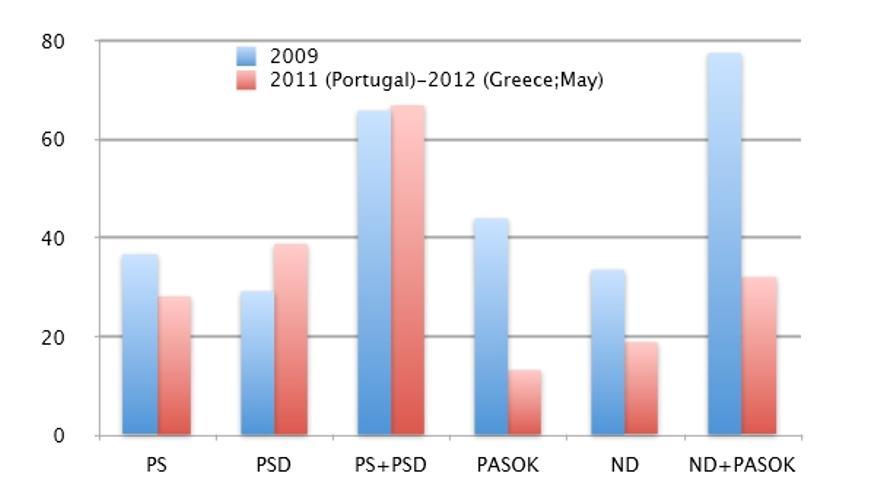
So, if we want to treat party system “resilience” or ”change” as the thing we want to explain, what are the two cases among the ”financial crisis” countries where party systems were more badly shaken? Interestingly, and, I think, countering Afonso’s argument, these are precisely the two cases where ”technocratic” or “national unity” governments were formed. In Greece, it is fascinating to see how the performance of ND in the polls plummeted in the aftermath of the formation of the Papademos cabinet in November 2011. In Italy, one and a half years of Monti (as well as Berlusconi’s tactical withdrawal of support by the end of the term) ended up leaving the Democratic Party awkwardly associated with austerity and crisis, something that, in other circumstances, an opposition party would probably be able to avoid (if not capitalize from). The result, in both countries, is that the punishment of incumbents was not accompanied by a reward for the main challengers in the party system. Instead, protest voting appeared with enormous strength and new parties emerged or strengthened, a result, I would argue, of the shared responsibility of the major traditional parties for increasingly detested policies and their consequences.
So to me, the question is: why have the Greek and Italian party systems been so transformed, while the Portuguese, Irish, and Icelandic ones were less so? The answer, I think, may be the opposite to the one provided by Afonso: cases of “national unity”/”technocratic” governments were followed by the deeper manifestations of party system transformation. In contrast, where party government prevailed, punishments for incumbents may have been very large in some cases and smaller in others, but party systems seem (so far) to have basically preserved most of their main features.
P.S.- I cautiously avoided Spain where, in the absence of any sort of “national unity” or “technocratic” cabinets, there’s an argument to be made about an important change away from a basic two-party system and towards a more fragmented one. However, this is mostly based on polling data, and I would reserve judgment on this until an actual election takes place…
terça-feira, julho 16, 2013
Uma frincha
Vou fazer agora uma coisa para a qual não tenho jeito nenhum: aquilo a que se costuma chamar "análise política". O meu negócio é outro, mas perdoem a incursão em terreno alheio. É porque há uma passagem muito curiosa num artigo de Leonete Botelho e Sofia Rodrigues no Público de hoje que não resisto comentar:
Para além de eu ser distraído e ignorante, há também a possibilidade destes "pedidos" feitos há muito terem sido privados, ou até, que sei eu, de estarmos perante uma oportuna reconstrução da história política recente. Mas isso agora não interessa muito. O interessante é que de repente vejo, não uma "janela de oportunidade", mas pelo menos uma pequenina frincha por onde pode passar um acordo entre os três partidos. O PS consensualiza objectivos de ajustamento mais modestos com o Governo, os nossos credores aceitam a coisa e continuam a mandar os cheques, Seguro reclama para si o mérito de "fazer ver" à maioria os seus erros passados e o PSD e o CDS evitam eleições antecipadas potencialmente catastróficas (especialmente para o segundo, se as indicações desta sondagem se confirmarem).
Contudo, a frincha continua a ser muito estreita. Se esses objectivos consensualizados incluírem "concordar com despedimentos, cortes nas pensões", a coesão interna no PS deverá estar em risco, se José Sócrates servir de barómetro para esse efeito (e provavelmente serve). E mesmo sem contar com isso, para o PS, a equação eleitoral não é inequivocamente favorável a qualquer espécie de acordo com os partidos de governo: CDU e BE espreitam, e um ano (até menos que isso) de "salvação nacional" é muito, muito tempo. Mas a frincha está lá.
Desde há muito que a maioria e o Governo pediam um entendimento com o PS que tinha por objectivo fazer pressão à troika para ganhar vantagens nas negociações. Com isso, a maioria apresentava como argumento perante a troika um apoio reforçado no Parlamento, mas também ganhava margem para negociar matérias, como a flexibilização do défice, a coberto do PS, com o argumento de que os socialistas eram menos receptivos a medidas que implicam cortes na despesa social.Só comprovo a minha distracção e a minha ignorância, mas confesso que não sabia nada disto. Eu sabia, por exemplo, que o Primeiro-Ministro não excluía a possibilidade de flexibilizar a meta do défice para 2014, "mas faremos tudo o que está ao nosso alcance para cumprir as metas que foram agora acordadas no sétimo exame regular", e até já tem "prontos os diplomas que terminam os cortes de 4,3 mil milhões de euros que foram acordados para 2014". Sabia também que o CDS considerava que "factores externos" faziam com que fosse "prudente" admitir a possibilidade de nova flexibilização das metas do défice para 2014, mas pouco mais para além de dezenas de notícias injectadas nos jornais sobre nunca claramente assumidas posições do partido e do seu líder sobre o programa de ajustamento. O que eu não sabia era que o Governo, por considerar essas metas impossíveis (ou até, quem sabe, indesejáveis), andava há muito a pedir um entendimento com o PS para, usando o PS como "desculpa" ou para mostrar base de apoio doméstico, ganhar poder negocial frente à troika para renegociar as metas acordadas.
Para além de eu ser distraído e ignorante, há também a possibilidade destes "pedidos" feitos há muito terem sido privados, ou até, que sei eu, de estarmos perante uma oportuna reconstrução da história política recente. Mas isso agora não interessa muito. O interessante é que de repente vejo, não uma "janela de oportunidade", mas pelo menos uma pequenina frincha por onde pode passar um acordo entre os três partidos. O PS consensualiza objectivos de ajustamento mais modestos com o Governo, os nossos credores aceitam a coisa e continuam a mandar os cheques, Seguro reclama para si o mérito de "fazer ver" à maioria os seus erros passados e o PSD e o CDS evitam eleições antecipadas potencialmente catastróficas (especialmente para o segundo, se as indicações desta sondagem se confirmarem).
Contudo, a frincha continua a ser muito estreita. Se esses objectivos consensualizados incluírem "concordar com despedimentos, cortes nas pensões", a coesão interna no PS deverá estar em risco, se José Sócrates servir de barómetro para esse efeito (e provavelmente serve). E mesmo sem contar com isso, para o PS, a equação eleitoral não é inequivocamente favorável a qualquer espécie de acordo com os partidos de governo: CDU e BE espreitam, e um ano (até menos que isso) de "salvação nacional" é muito, muito tempo. Mas a frincha está lá.
segunda-feira, julho 15, 2013
Mais sobre a sondagem Aximage
A Aximage pede aos inquiridos que avaliem os principais líderes políticos como tendo actuado "bem", "mal" ou "assim-assim". Depois atribui valores de 3, -3, e 1 a cada uma das opções (-1 sem opinião). Depois agrega e converte numa numa escala de 0 a 20. É um pouco complicado (porventura excessivamente complicado), mas a regra é explicada e consistente, e logo a comparabilidade é possível. Eis a evolução:
 O tombo do líder do CDS-PP é grande. Em consistência com os resultados de intenção de voto do PSD na mesma sondagem, Passos Coelho sobe. Para já, a indicação é esta: o conjunto de episódios em torno da demissão de Portas penalizou-o fundamentalmente a ele e ao seu partido, mas não o seu parceiro de coligação. Mas são indicações a confirmar (ou não) com mais sondagens que sejam realizadas após a crise da coligação.
domingo, julho 14, 2013
sexta-feira, julho 12, 2013
Eurosondagem, 5-10 julho 2013, N=1007, Tel.
PS: 37% (+0.1)
PSD: 25% (+0.2)
CDU: 12% (-0.1)
CDS-PP: 8% (+0.3)
BE: 8% (=)
Paulo Portas e Passos Coelho são os líderes políticos cuja aprovação mais desceu. Aqui. Se tivesse tempo, tentaria calcular a probabilidade de duas amostras aleatórias (esta e a do mês anterior) darem resultados quase exactamente iguais, presumindo que a distribuição de intenções no universo é igual.
P.S.- Boa ideia a apresentação de %'s sem casas decimais. A ver se continua.
PSD: 25% (+0.2)
CDU: 12% (-0.1)
CDS-PP: 8% (+0.3)
BE: 8% (=)
Paulo Portas e Passos Coelho são os líderes políticos cuja aprovação mais desceu. Aqui. Se tivesse tempo, tentaria calcular a probabilidade de duas amostras aleatórias (esta e a do mês anterior) darem resultados quase exactamente iguais, presumindo que a distribuição de intenções no universo é igual.
P.S.- Boa ideia a apresentação de %'s sem casas decimais. A ver se continua.
segunda-feira, julho 08, 2013
Pitagórica, 28 Junho-2 Julho, N=503, Tel.
Intenções de voto. Entre parêntesis, comparação com sondagem anterior (trabalho de campo terminado a 28 de Maio):
PS: 33.9% (+1.2)
PSD: 23.7% (-1.7)
CDU: 13.2% (+0.7)
CDS-PP: 9.1% (-0.4)
BE: 8.9% (-0.5)
Aqui. Outros resultados:
* 57% (contra 33%) acham que "um governo de coligação entre o PS, o PCP e o Bloco de Esquerda" não "seria capaz de responder aos desafios que Portugal está a viver".
* 40% acham que "chegaremos a Junho de 2014" "melhor"ou "muito melhor", enquanto que 32% "pior" ou "muito pior".
* 66% acham "devem-se fazer as eleições no seu período normal" (contra 31% que querem legislativas com autárquicas).
PS: 33.9% (+1.2)
PSD: 23.7% (-1.7)
CDU: 13.2% (+0.7)
CDS-PP: 9.1% (-0.4)
BE: 8.9% (-0.5)
Aqui. Outros resultados:
* 57% (contra 33%) acham que "um governo de coligação entre o PS, o PCP e o Bloco de Esquerda" não "seria capaz de responder aos desafios que Portugal está a viver".
* 40% acham que "chegaremos a Junho de 2014" "melhor"ou "muito melhor", enquanto que 32% "pior" ou "muito pior".
* 66% acham "devem-se fazer as eleições no seu período normal" (contra 31% que querem legislativas com autárquicas).
sexta-feira, junho 28, 2013
PSD nas sondagens, 2001-2013
Graças ao trabalho incansável do Miguel Maria Pereira, bolseiro do projecto POPSTAR (em breve terei novidades que poderão ser interessantes), e da ajuda da ERC, temos agora uma coisa simples mas útil: uma base de dados das sondagens eleitorais desde 2001. Um exemplo abaixo do que se pode fazer com isto: a evolução das intenções de voto no PSD. Porque as sondagens divulgam os resultados de maneira diferente - com e sem indecisos, aplicando filtros que diminuem a % de brancos e nulos, etc. - estes resultados representam a % de intenções de voto no PSD em relação ao total dos 5 maiores partidos, de modo a aumentar a comparabilidade entre as diferentes sondagens. Logo, o que interessa aqui não é tanto uma comparação com resultados eleitorais reais (que serão sempre menores), mas sim a comparação ao longo do tempo. Sinalizei alguns factos políticos relevantes para nos situarmos. A linha é um smoother LOESS a 5%. É melhor clicar na imagem para ver bem.

Julgo que não precisa de muitos comentários. Talvez dizer que o declínio do PSD desde 2011, depois de uma breve fase inicial de sustentação (que Barroso não teve), tornou-se logo de seguida mais acentuado e rápido que o que sofreu desde 2002 e que, hoje, o PSD está com intenções de voto nos mínimos dos últimos 12 anos, mas que esses mínimos já foram atingindos em várias circunstâncias (Santana Lopes, Menezes, Ferreira Leite). A dúvida, claro, é o que pode estar ainda para vir.


Julgo que não precisa de muitos comentários. Talvez dizer que o declínio do PSD desde 2011, depois de uma breve fase inicial de sustentação (que Barroso não teve), tornou-se logo de seguida mais acentuado e rápido que o que sofreu desde 2002 e que, hoje, o PSD está com intenções de voto nos mínimos dos últimos 12 anos, mas que esses mínimos já foram atingindos em várias circunstâncias (Santana Lopes, Menezes, Ferreira Leite). A dúvida, claro, é o que pode estar ainda para vir.
terça-feira, junho 25, 2013
Um inquérito, um pedido de ajuda, e prémios!
Uma investigadora da Nova SBE, Ana Cláudia Gouveia, no contexto da sua tese de doutoramento, desenvolveu um questionário online sobre pensões de reforma. Era muito importante que o questionário fosse respondido pelo número mais alargado possível de pessoas, pelo que venho pedir-vos ajuda no sentido lhe responderem e circularem o link. Responde-se AQUI. E pode dar um prémio! (a sério).
O link por extenso, para copiarem e enviarem para outros, se puderem: https://novasbe.qualtrics.com/SE/?SID=SV_6lng3AfIhrmYiCV
O link por extenso, para copiarem e enviarem para outros, se puderem: https://novasbe.qualtrics.com/SE/?SID=SV_6lng3AfIhrmYiCV
terça-feira, junho 18, 2013
The polls in Portugal

PSD's decline is steeper than PS's rise, since smaller parties - not the government partner CDS-PP, but rather BE and, especially, CDU - seem to be on the rise too. Not quite like Spain, where IU and UPyD are now worth something like 30% of vote intentions. However, these two Portuguese parties, both to the left of the Socialists, are clearly worth a combined 20% of vote intentions. BE's potential in an actual election is always a bit questionable, as it has a more fickle and volatile electorate. But CDU's performance deserves greater atention. Although the Communists typically have good polls in the middle of electoral cycles and always tend to decline as the election approaches and campaigns start mobilizing other sorts of voters, CDU hasn't had such a consistent string of good results in polls since at least 2005. And let's say they get 10% in the next election. This would be their best score since...1987.
quarta-feira, junho 12, 2013
Marktest, 27-30 Maio, N=802, Tel.
PS: 34,6% (+2)
PSD: 25,0% (-2.9)
CDU: 13,1% (+0,7)
BE: 8.2% (-5,1)
CDS-PP: 5,6% (+0.4)
OBN: 13,6% (+5,0)
Aqui.
PSD: 25,0% (-2.9)
CDU: 13,1% (+0,7)
BE: 8.2% (-5,1)
CDS-PP: 5,6% (+0.4)
OBN: 13,6% (+5,0)
Aqui.
sexta-feira, junho 07, 2013
quarta-feira, maio 29, 2013
Government effectiveness and support for democracy
I just published an article on EJPR with the same title as this post. For those of you that may be interested on the subject but not so interested as to read the whole thing, here's an attempted summary.
Looking at survey data, many scholars have found that whether individuals prefer Democracy to alternative types of regimes is something that is unrelated with individual ("subjective") perceptions of governmental or economic performance, or even with "objective" measures of economic performance. The conclusion that has been reached on this basis can be summarized thus: "popular belief in the superiority of democracy is not susceptible to the ups-and-downs of government performance or the short-term economic fluctuation.” Instead, it “is largely a principled affair”, "a stable cognitive value cultivated through the socialization process in the society."
This finding seems to fit the basic conjecture that David Easton made a long time ago about the difference between "specific" and "diffuse support". Specific support is directed to "the perceived decisions, policies, actions, and the general style of (…) authorities.” In turn, diffuse support,“representing as it does attachment to political objects for their own sake, will not be easily dislodged because of current dissatisfaction with what the government does.” To put this in a simpler way, people's reasons to be happy or unhappy with the way the regime they live under works may very well be shaped by short-term factors related to the performance of governments or of the economy. But whether they are "democrats", or better put, whether they believe democracy to be "the only game in town" and to see it as "legitimate", is shaped by deeper, more structural, longer-term forces.
My point in this article is, I hope, very simple. I question the previous ideas in three ways. First, upon careful rereading of Easton and others, we find that this is not exactly what they conjectured. There's a very nice quote from a 1975 piece by Easton on this subject:
Second, following recent work on the subject, I argue that one of the reasons why this has not been borne out by the data may be the use of inappropriate measures of regime support. Asking people directly about whether they "prefer democracy to other regimes" or whether they think "democracy is a good thing" is just one way of measuring support. There are different and more indirect ways, which focus more on whether people reject autocratic alternatives or whether they perceive an inevitable trade-off between "democracy" and universally valued outcomes, such as prosperity, decisiveness, and order. If we employ those measures, arguably less prone to "democratic lip service" and demonstrably more valid in cross-national research, maybe we will find that support for democracy is less prevalent than what people think, and more vulnerable to regime performance that what has been suggested.
Third, and finally, I argue that measures of regime performance could focus more on outputs than outcomes. In other words, effectiveness should be measured in terms of the quality of policy formulation and implementation, rather than economic outcomes or the perception of those outcomes. In spite of its arguable failings, there is an available measure that fulfills these criteria and has been used extensively in cross-national research: the World Bank's "government effectiveness" indicator.
What follows is quite simple. I use the World Values Survey integrated data file, construct three measures of regime support - one more "explicit" (EDS), another capturing rejection of autocratic alternatives (DAP), and another capturing whether people reject an inevitable trade-off between democracy and universally valued goals (DPE) - and pose two hypotheses.
H1. In democracies, greater effectiveness is linked to stronger democratic support.
H2. In non-democracies, greater effectiveness is linked to weaker democratic support (this is not really what one would like to test. Instead, one would like to test whether effectiveness in non-democracies increases support for whatever type of non-democracy people live under, but we simply have no good measures of that).
I use a multilevel model applied to data from never less than 50 countries and 76 surveys (depending on the availability of data), taking into account that respondents are clustered in country-years and those in countries, add a series of contextual and individual-level controls (GDP per capita, Ethnic fractionalization, Years under democracy, Income inequality, Age, Gender, Education, Income, Social trust, etc), and estimate the impact of Government effectiveness on the three measures of democratic support in different regime-types ("democracies" vs. "non-democracies", measured in two alternative ways). The take home figure is this, showing the marginal effects of effectiveness on these measures of democratic support:

When we use explicit measures of democratic support, support for H1 is absent. However, when we use alternative measures of support, effectiveness has a relevant positive impact in democratic support in democratic regimes (one standard deviation increase in effectiveness increases democratic support - DAP or DPE - by 2/3 of a standard deviation). Support for H2 is slimmer. Still, several of the marginal effects are negative, and two are significant at conventional levels. In short, effectiveness in democracies is a correlate of democratic support. Note also that all other macro-level predictors fail to perform as some of the literature suggests they should, at least once effectiveness is taken into account.
It's a very simple idea, but I hope it is reasonably well executed. The message is less optimistic than what a democrat would like. Democracies are not immune to the consequences of government ineffectiveness and bad policy-making. Ineffective democracies are likely to suffer in terms of their legitimacy near mass publics. And there are signs, to be confirmed with better data, that effective autocracies may be more stable than what we think, by diminishing demand for democracy and increasing their own legitimacy.
That's it. I plan to continue to work on this issue. Comments very welcome.
Looking at survey data, many scholars have found that whether individuals prefer Democracy to alternative types of regimes is something that is unrelated with individual ("subjective") perceptions of governmental or economic performance, or even with "objective" measures of economic performance. The conclusion that has been reached on this basis can be summarized thus: "popular belief in the superiority of democracy is not susceptible to the ups-and-downs of government performance or the short-term economic fluctuation.” Instead, it “is largely a principled affair”, "a stable cognitive value cultivated through the socialization process in the society."
This finding seems to fit the basic conjecture that David Easton made a long time ago about the difference between "specific" and "diffuse support". Specific support is directed to "the perceived decisions, policies, actions, and the general style of (…) authorities.” In turn, diffuse support,“representing as it does attachment to political objects for their own sake, will not be easily dislodged because of current dissatisfaction with what the government does.” To put this in a simpler way, people's reasons to be happy or unhappy with the way the regime they live under works may very well be shaped by short-term factors related to the performance of governments or of the economy. But whether they are "democrats", or better put, whether they believe democracy to be "the only game in town" and to see it as "legitimate", is shaped by deeper, more structural, longer-term forces.
My point in this article is, I hope, very simple. I question the previous ideas in three ways. First, upon careful rereading of Easton and others, we find that this is not exactly what they conjectured. There's a very nice quote from a 1975 piece by Easton on this subject:
"Diffuse support may also, however, derive from experience. If only because this is a source usually associated with specific support, its significance for diffuse support may easily be overlooked or underemphasized. Members do not come to identify with basic political objects only because they have learned to do so through inducements offered by others – a critical aspect of socialization processes. If they did, diffuse support would have entirely the appearance of a non-rational phenomenon. Rather, on the basis of their own experiences, members may also judge the worth of supporting these objects for their own sake. Such attachment may be a product of spill-over effects from evaluations of a series of outputs and of performance over a long period of time" (Easton 1975: 446)Others, like Lipset, Dahl or Linz, made similar conjectures. Rational people living under ineffective regimes will sooner or later question their legitimacy.
Second, following recent work on the subject, I argue that one of the reasons why this has not been borne out by the data may be the use of inappropriate measures of regime support. Asking people directly about whether they "prefer democracy to other regimes" or whether they think "democracy is a good thing" is just one way of measuring support. There are different and more indirect ways, which focus more on whether people reject autocratic alternatives or whether they perceive an inevitable trade-off between "democracy" and universally valued outcomes, such as prosperity, decisiveness, and order. If we employ those measures, arguably less prone to "democratic lip service" and demonstrably more valid in cross-national research, maybe we will find that support for democracy is less prevalent than what people think, and more vulnerable to regime performance that what has been suggested.
Third, and finally, I argue that measures of regime performance could focus more on outputs than outcomes. In other words, effectiveness should be measured in terms of the quality of policy formulation and implementation, rather than economic outcomes or the perception of those outcomes. In spite of its arguable failings, there is an available measure that fulfills these criteria and has been used extensively in cross-national research: the World Bank's "government effectiveness" indicator.
What follows is quite simple. I use the World Values Survey integrated data file, construct three measures of regime support - one more "explicit" (EDS), another capturing rejection of autocratic alternatives (DAP), and another capturing whether people reject an inevitable trade-off between democracy and universally valued goals (DPE) - and pose two hypotheses.
H1. In democracies, greater effectiveness is linked to stronger democratic support.
H2. In non-democracies, greater effectiveness is linked to weaker democratic support (this is not really what one would like to test. Instead, one would like to test whether effectiveness in non-democracies increases support for whatever type of non-democracy people live under, but we simply have no good measures of that).
I use a multilevel model applied to data from never less than 50 countries and 76 surveys (depending on the availability of data), taking into account that respondents are clustered in country-years and those in countries, add a series of contextual and individual-level controls (GDP per capita, Ethnic fractionalization, Years under democracy, Income inequality, Age, Gender, Education, Income, Social trust, etc), and estimate the impact of Government effectiveness on the three measures of democratic support in different regime-types ("democracies" vs. "non-democracies", measured in two alternative ways). The take home figure is this, showing the marginal effects of effectiveness on these measures of democratic support:
When we use explicit measures of democratic support, support for H1 is absent. However, when we use alternative measures of support, effectiveness has a relevant positive impact in democratic support in democratic regimes (one standard deviation increase in effectiveness increases democratic support - DAP or DPE - by 2/3 of a standard deviation). Support for H2 is slimmer. Still, several of the marginal effects are negative, and two are significant at conventional levels. In short, effectiveness in democracies is a correlate of democratic support. Note also that all other macro-level predictors fail to perform as some of the literature suggests they should, at least once effectiveness is taken into account.
It's a very simple idea, but I hope it is reasonably well executed. The message is less optimistic than what a democrat would like. Democracies are not immune to the consequences of government ineffectiveness and bad policy-making. Ineffective democracies are likely to suffer in terms of their legitimacy near mass publics. And there are signs, to be confirmed with better data, that effective autocracies may be more stable than what we think, by diminishing demand for democracy and increasing their own legitimacy.
That's it. I plan to continue to work on this issue. Comments very welcome.
quarta-feira, maio 22, 2013
Aximage, 7-10 maio, N=604, Tel.
PS: 35.5% (+2.9)
PSD: 26.2% (+0.9)
CDS-PP: 9.5% (+0.1)
CDU: 9.4% (-2.6)
BE: 6.9 (-0.9)
Aqui, com atraso meu.
PSD: 26.2% (+0.9)
CDS-PP: 9.5% (+0.1)
CDU: 9.4% (-2.6)
BE: 6.9 (-0.9)
Aqui, com atraso meu.
Autárquicas e legislativas
Hoje passei por Oeiras e vi os cartazes da candidatura de Moita Flores:

Não vivo para estes lados e talvez por isso não faça ideia de quem é a nova Catarina mas notei duas coisas. A primeira é a ausência de menção aos partidos que apoiam a candidatura. A segunda é algo que não se vê aqui: em todos os cartazes que vi hoje, alguém tinha pintado "PSD". Obviamente, muitos candidatos do PSD pelo país fora tentarão omitir qualquer referência ao seu partido, enquanto muitos dos seus adversários farão o possível por chamar a atenção para ele. Mas isto fez-me pensar nos resultados das eleições autárquicas e na sua relação com a política nacional.
Tivemos 10 autárquicas até ao momento (excluindo intercalares). Que resultados tiveram os partidos do governo nessas eleições, e como se comparam eles com os resultados que obtiveram nas legislativas anteriores? No gráfico seguinte, comparo a percentagem de votos obtida pelos partidos no governo nas autárquicas (Câmara Municipal) com o resultado das legislativas anteriores. Nos casos em que há um partido de governo que concorreu em coligações pré-eleitorais nalgumas câmaras, extraí desses resultados a componente do partido de governo na base da distribuição dos total dos votos nos casos em que os partidos dessas coligações concorreram separados.

O desfecho mais frequente é que os partidos de governo sofram perdas nas autárquicas (-4.5 pontos, em média). Mas há grande dispersão: há três eleições com ganhos, assim como duas eleições com perdas catastróficas (acima dos 16 pontos, para o PSD, em 1989 e 1993).
O gráfico abaixo mostra a relação entre as perdas sofridas pelo(s) partido(s) de governo e o tempo decorrido após as legislativas. Os únicos casos em que os partidos de governo ganharam em relação às legislativas anteriores foi quando as autárquicas tiveram lugar imediatamente depois dessas legislativas, beneficiando aparentemente assim de um efeito de "lua de mel" e porventura do facto de, para os eleitores, o "incumbente" ser ainda outro (o que pode explicar os resultados particulamente bons para a AD em 1979 ou para o PSD em 1985 mas não a subida do PS em 2009). Em eleições autárquicas aproximadamente a meio do ciclo das legislativas, há sempre perdas, mas essas perdas podem ser relativamente pequenas (AD em 1982, PS em 1997) ou tremendas (PSD em 1989 e 1993).
 As próximas autárquicas terão lugar cerca de 850 dias depois das legislativas de 2011. Se quisermos ser amáveis para a actual coligação de governo, podemos fixar-lhe um objectivo modesto: conseguirão os seus partidos em conjunto mais de 33% dos votos nessas autárquicas (tendo assim perdas inferiores ao PSD em 1993) ou ficarão abaixo desse resultado?
Não vivo para estes lados e talvez por isso não faça ideia de quem é a nova Catarina mas notei duas coisas. A primeira é a ausência de menção aos partidos que apoiam a candidatura. A segunda é algo que não se vê aqui: em todos os cartazes que vi hoje, alguém tinha pintado "PSD". Obviamente, muitos candidatos do PSD pelo país fora tentarão omitir qualquer referência ao seu partido, enquanto muitos dos seus adversários farão o possível por chamar a atenção para ele. Mas isto fez-me pensar nos resultados das eleições autárquicas e na sua relação com a política nacional.
Tivemos 10 autárquicas até ao momento (excluindo intercalares). Que resultados tiveram os partidos do governo nessas eleições, e como se comparam eles com os resultados que obtiveram nas legislativas anteriores? No gráfico seguinte, comparo a percentagem de votos obtida pelos partidos no governo nas autárquicas (Câmara Municipal) com o resultado das legislativas anteriores. Nos casos em que há um partido de governo que concorreu em coligações pré-eleitorais nalgumas câmaras, extraí desses resultados a componente do partido de governo na base da distribuição dos total dos votos nos casos em que os partidos dessas coligações concorreram separados.

O gráfico abaixo mostra a relação entre as perdas sofridas pelo(s) partido(s) de governo e o tempo decorrido após as legislativas. Os únicos casos em que os partidos de governo ganharam em relação às legislativas anteriores foi quando as autárquicas tiveram lugar imediatamente depois dessas legislativas, beneficiando aparentemente assim de um efeito de "lua de mel" e porventura do facto de, para os eleitores, o "incumbente" ser ainda outro (o que pode explicar os resultados particulamente bons para a AD em 1979 ou para o PSD em 1985 mas não a subida do PS em 2009). Em eleições autárquicas aproximadamente a meio do ciclo das legislativas, há sempre perdas, mas essas perdas podem ser relativamente pequenas (AD em 1982, PS em 1997) ou tremendas (PSD em 1989 e 1993).

Subscrever:
Mensagens (Atom)